
From Metals Momentum to Risk Control: COM’s Tactical Win in Q4
The Direxion Auspice Broad Commodity Strategy ETF (Ticker: COM) delivered positive performance in 2025, returning +7.70% for the full year. During the fourth quarter, COM gained +3.53%, outperforming several notable broad commodity benchmarks. The Fund’s tactical, trend-following approach helped mitigate downside risk across the broader Agriculture complex, — particularly in Wheat and Cotton — where traditional long-only, static commodity strategies remained exposed.
To view the Fund's full standardized performance, click here.
The performance data quoted represents past performance. Past performance does not guarantee future results. The investment return and principal value of an investment will fluctuate. An investor’s shares, when redeemed, may be worth more or less than their original cost. Current performance may be lower or higher than the performance quoted. Returns for performance under one year are cumulative, not annualized. For the most recent month-end performance please visit the funds website at www.direxion.com.
The Auspice Broad Commodity Excess Return Index (ABCERI)*, which the COM ETF seeks to track, was long six of the twelve eligible commodities entering 2026: Gold, Silver, Copper, Gasoline, Heating Oil, and Soybeans.
Because the strategy gains exposure through futures contracts with relatively low margin requirements, the Fund maintains excess cash even when fully invested. In the current interest-rate environment, this cash allocation has the potential to enhance overall returns through income and yield generation.
Broader Commodity Market Trends
Broad commodity benchmarks posted positive returns for 2025, while fourth-quarter performance ranged from flat to modestly positive. During Q4, both the Bloomberg Commodity Index (BCOM)* and the Deutsche Banc Liquid Commodity Optimum Yield Index* advanced, driven primarily by strength in Industrial Metals and Precious Metals. In contrast, the S&P GSCI Index* finished the quarter relatively flat due to its heavier concentration in Energy markets, which underperformed during the period.
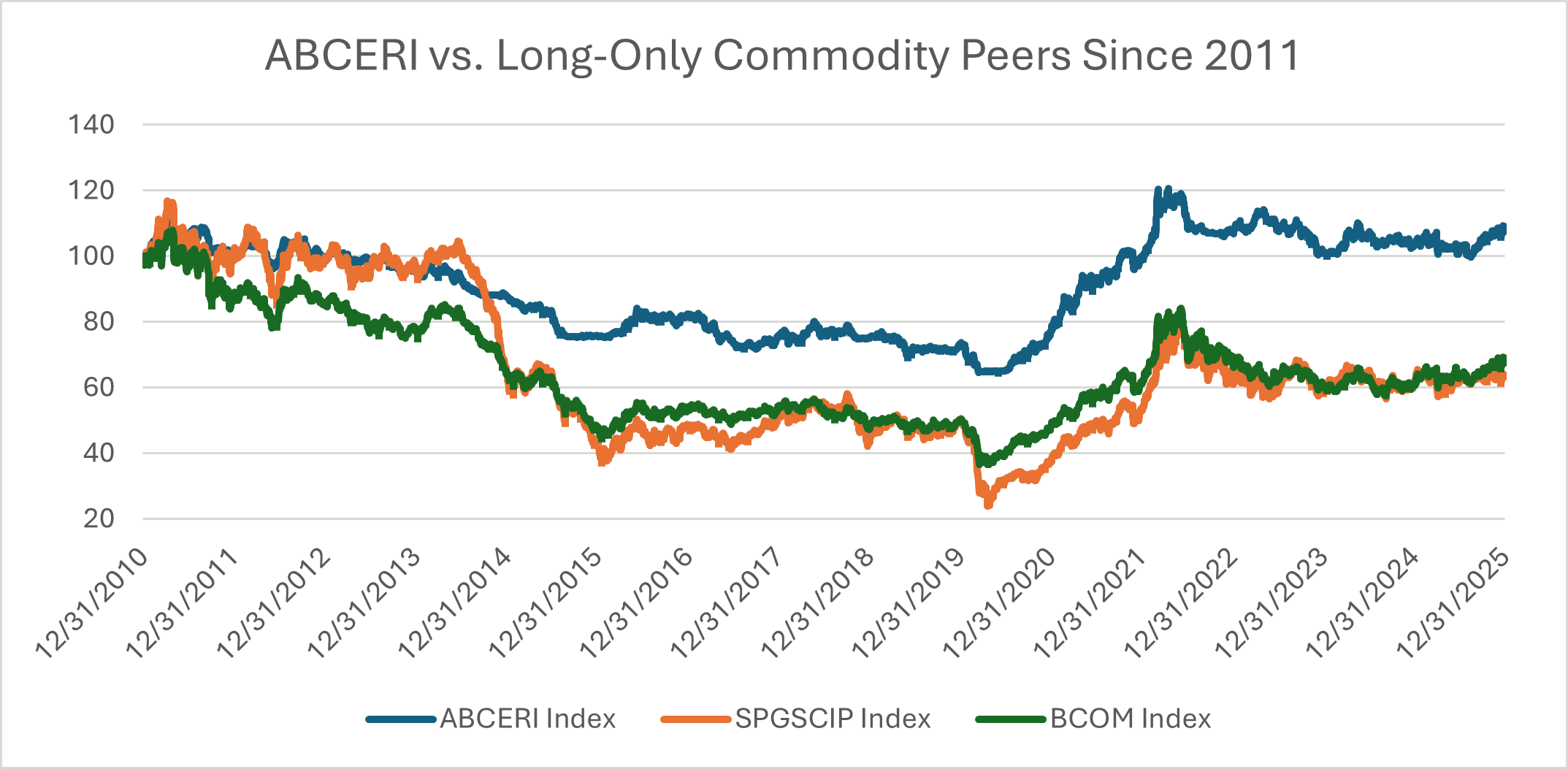
| ABCERI Index | SPGSCI Index | BCOM Index | |
| Annual Std. Deviation | 8.30% | 20.51% | 13.99% |
| Max Drawdown | -35.36% | -76.20% | -63.37% |
Source: Bloomberg, from 12/31/2010 to 12/31/2025
Standard Deviation is a measure of the dispersion of a set of data from its mean.
Maximum Drawdown is the greatest percent decline from a previous high.
Performance Highlights by Sector
Metals
Metals were the strongest-performing sector during the quarter, with Gold, Silver, and Copper posting three consecutive months of gains to close out the year.
Silver outshined gold in Q4, supported by a combination of structural supply constraints and accelerating industrial demand. Much of global silver production occurs as a byproduct of other metals, contributing to persistent supply deficits. At the same time, silver’s critical role in solar energy, electric vehicles (EVs), and semiconductors has driven industrial demand to record levels in 2025. These dynamics helped push silver prices to new highs in December. In addition, Silver also exhibits haven-like characteristics, making it attractive to some investors who want to invest outside of Gold.
Gold benefited from a convergence of ongoing geopolitical risks, shifting monetary policy expectations, and a weakening U.S. dollar, reinforcing its role as a preferred haven. Federal Reserve rate cuts in October and December, alongside expectations for additional easing in 2026, increased gold’s appeal in a lower-rate environment. Gold reached record price levels in 2025, marking one of its strongest annual performances on record.
COM maintained long exposure to all three metals throughout the quarter. Metals represented the Fund’s top-performing sector for both Q4 and full-year 2025.
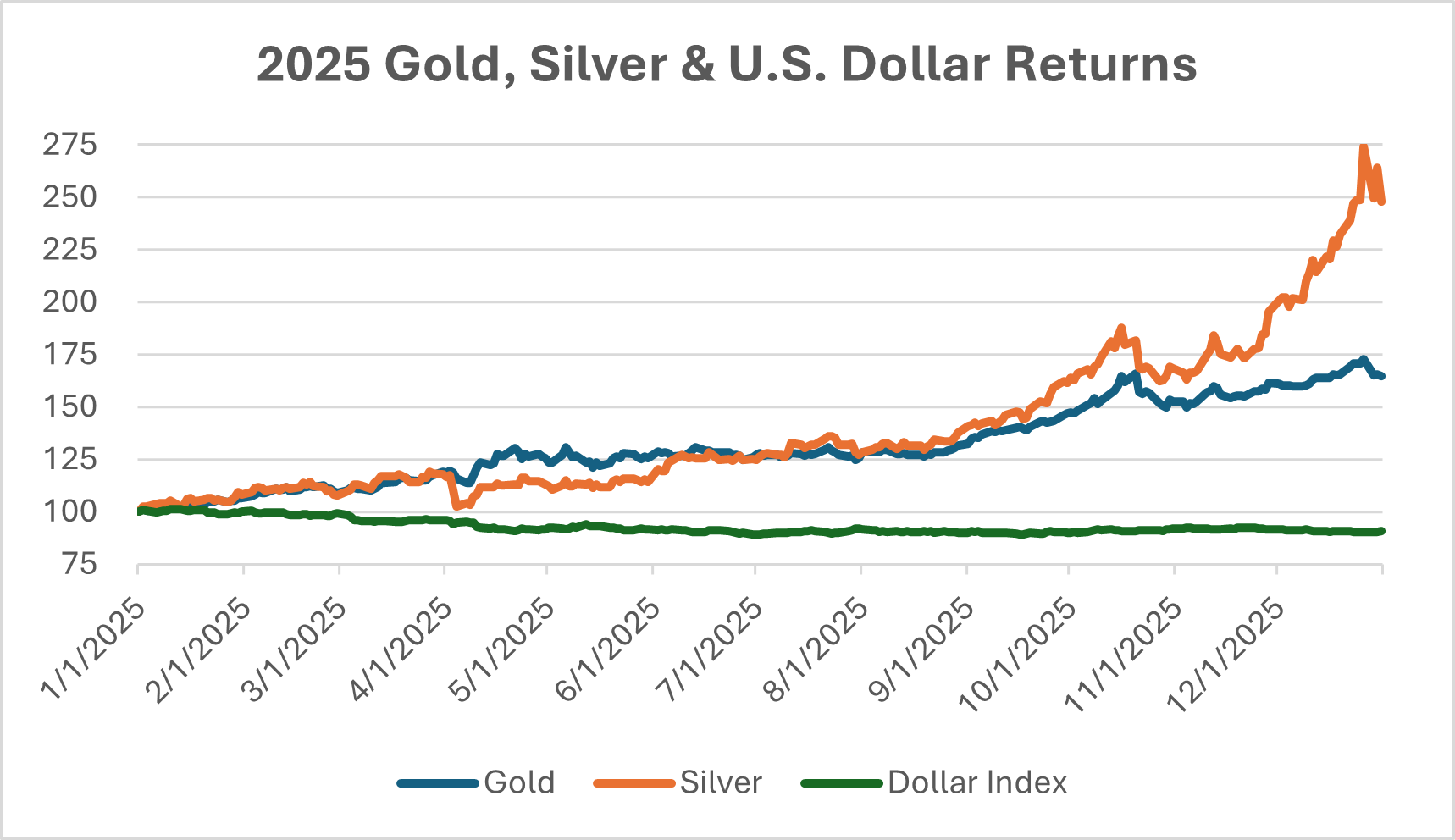
Source: Bloomberg, from 1/1/2025 to 12/31/2025
Correlation of the U.S. Dollar Index to Gold and Silver
| DXY : Gold | -0.24 |
| DXY : Silver | -0.32 |
Source: Bloomberg, from 1/1/1970 to 12/31/2025
*DXY: The U.S. Dollar Index measures the value of the US Dollar against a basket of six major foreign currencies.
Energy
Energy markets experienced mixed performance during the quarter. Crude Oil faced downward pressure as global oversupply emerged as a dominant theme, driven by OPEC+ unwinding prior production cuts, and continued elevated output from non-OPEC producers.
Natural Gas experienced heightened volatility during Q4. Prices surged to multi-year highs in early December following an early-season cold snap, before reversing sharply as weather forecasts shifted toward milder conditions. The COM ETF added exposure to Natural Gas early in December and exited later in the month to help protect capital amid rapidly changing fundamentals.
Agriculture
Agriculture markets, including Grains and Soft Commodities, ended the quarter lower. Except for Soybeans, the COM ETF maintained no exposure to these markets, allowing it to differentiate itself from static, long-only peers that remained fully invested in underperforming agricultural commodities. This positioning contributed to relative outperformance during the quarter.
To view the Fund's full positioning, please click here.
Outlook
As commodity markets enter 2026, persistent inflation*, evolving monetary policy expectations, and elevated geopolitical risk are likely to contribute to continued volatility and uneven performance across commodity sectors. Shifts in real interest rates, the U.S. dollar, and supply-side dynamics may drive frequent changes in market leadership across Metals, Energy, and Agriculture, reinforcing the importance of adaptability.
In this environment, COM’s systematic, trend-following approach is designed to dynamically adjust exposure based on price trends, seek participation in commodities exhibiting sustained momentum, and move defensively when trends weaken — supporting its objective of delivering broad commodity exposure while actively managing risk across changing market conditions for long-term, risk-aware investors.
*Definitions and Index Descriptions
An investor should carefully consider the Fund’s investment objective, risks, charges, and expenses before investing. The Fund’s prospectus and summary prospectus contain this and other information about the Direxion Shares. To obtain the Fund’s prospectus and summary prospectus call 866-476-7523 or visit our website at www.direxion.com. The Fund’s prospectus and summary prospectus should be read carefully before investing.
The Auspice Broad Commodity Index (ABCERI) is a rules-based long/flat broad commodity index that seeks to capture the majority of the commodity upside returns, while seeking to mitigate downside risk. The Index is made up of a diversified portfolio of 12 commodities futures contracts (Silver, Gold, Copper, Heating Oil, Natural Gas, Gasoline, Crude Oil, Wheat, Soybeans, Corn, Cotton, and Sugar) that based on price trends can individually be Long or Flat (in Cash). One cannot directly invest in an index.
The S&P GSCI Index (SPGSCI) is a composite index of commodity sector returns representing an unleveraged, long-only investment in commodity futures that is broadly diversified across the spectrum of commodities.
The Bloomberg Commodity Excess Return Index (BCOM) is a broadly diversified index that allows investors to track 19 commodity futures through a single, simple measure.
Deutsche Banc Liquid Commodity Optimum Yield Index (DBLCI-OY), an index composed of futures contracts on 14 of the most heavily-traded and important physical commodities in the world.
Direxion Shares Risks - An investment in the Fund involves risk, including the possible loss of principal. The Fund is non-diversified and includes risks associated with concentration that results from the Fund’s investments in a particular industry, sector, or geographic region which can result in increased volatility. The Fund’s use of derivatives such as futures contracts and swaps are subject to market risks that may cause their price to fluctuate over time. Risks of the Fund include, but are not limited to, Index Correlation Risk, Derivatives Risk, Commodity-Linked Derivatives Risk, Futures Strategy Risk, Passive Investment and Index Performance Risk, Counterparty Risk, Cash Transaction Risk, Subsidiary Investment Risk, Interest Rate Risk, and Tax Risk. Please see the summary and full prospectuses for a more complete description of these and other risks of the Fund.
Exchange-traded commodity futures contracts generally are volatile and are not suitable for all investors. The value of a commodity-linked derivative investment typically is based upon the price movements of a physical commodity and may be affected by changes in overall market movements, volatility of the index, changes in interest rates, or factors affecting a particular industry or commodity, such as global pandemics, weather and other natural disasters, changes in supply and production, embargoes, tariffs and international economic, political and regulatory developments and changes in speculators' and/or investors' demand. Commodity-linked derivatives also may be subject to credit and interest rate risks that in general affect the value of debt securities. The Fund’s investments in derivatives may pose risks in addition to, and greater than, those associated with directly investing in securities or other investments.
Risks associated with the use of futures contracts are (a) the imperfect correlation between the change in market value of the instruments held by the Fund and the price of the futures contract; (b) possible lack of a liquid secondary market for a futures contract and the resulting inability to close a futures contract when desired; (c) losses caused by unanticipated market movements, which are potentially unlimited; (d) the Index’s inability to predict correctly the direction of securities prices, interest rates, currency exchange rates and other economic factors; (e) the possibility that the counterparty will default in the performance of its obligations; and (f) if the Fund has insufficient cash, it may have to sell securities or financial instruments from its portfolio to meet daily variation margin requirements, which may lead to the Fund selling securities or financial instruments at a time when it may be disadvantageous to do so.
ALPS Distributors, Inc.