
Micron’s AI Boost: Bull Run or Bust Waiting to Happen?

Editor's note: Any and all references to time frames longer than one trading day are for purposes of market context only, and not recommendations of any holding time frame. Daily rebalancing ETFs are not meant to be held unmonitored for long periods. If you don't have the resources, time or inclination to constantly monitor and manage your positions, leveraged and inverse ETFs are not for you.
Micron Technology, Inc. (Ticker: MU) recently gave investors a surprise. The company lifted its fiscal Q4 2025 outlook, calling for $11.2 billion in sales—about half a billion more than it had expected just weeks earlier. Gross margins are also moving higher, now projected at 44.5%. The reason? Stronger prices for dynamic random-access memory (DRAM) chips and rising demand for high-bandwidth memory (HBM), the kind of advanced chips that power artificial intelligence (AI) data centers.
That news sent Micron’s stock higher, extending a rally that’s already seen shares climb more than 40% this year, according to Reuters. As of September 5th, the stock was trading near a 52-week high.
Below is a daily chart of MU, as of September 5, 2025.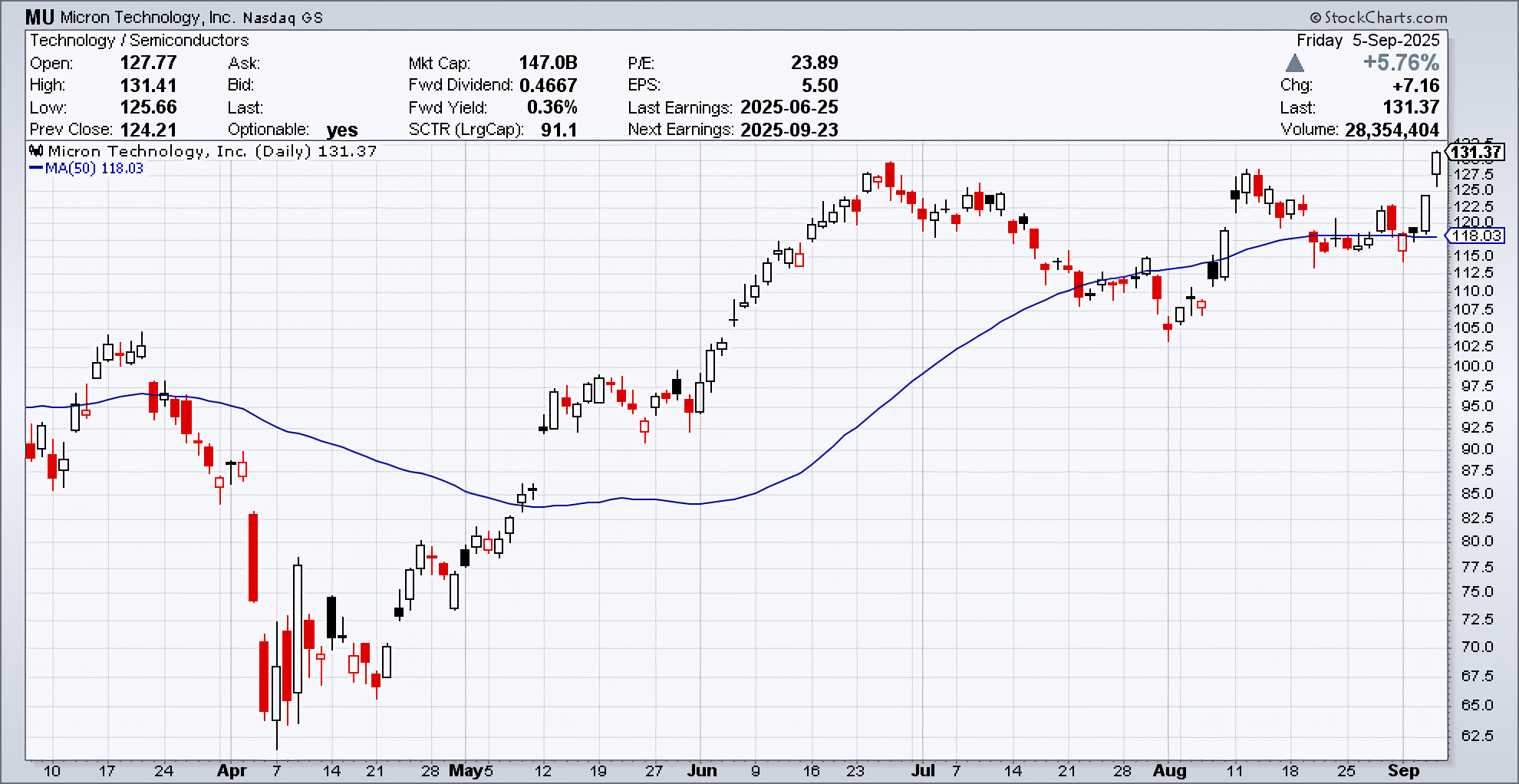
Source: StockCharts.com.
Candlestick charts display the high and low (the stick) and the open and close price (the body) of a security for a specific period. If the body is filled, it means the close was lower than the open. If the body is empty, it means the close was higher than the open.
The performance data quoted represents past performance. Past performance does not guarantee future results.
For traders, the setup looks tempting: Micron is at the heart of the AI boom. But the memory business has a long history of sharp ups and painful downs. The question is whether this time really is different—or if Micron’s latest run is just another turn in a familiar cycle.
Why Bulls Like Micron
For bulls, Micron’s story boils down to one thing: AI needs memory, and lots of it.
Every new wave of AI servers requires massive amounts of HBM to process data at lightning speeds. Micron’s HBM3E chips are already being used in Nvidia’s and AMD’s newest processors, with demand so strong that much of next year’s supply is spoken for, according to TradingNews. Unlike standard memory chips that trade more like commodities, HBM contracts are locked in ahead of time, giving Micron better visibility and stronger pricing.
Micron also has a scale advantage. Alongside Samsung and SK Hynix, it’s one of only three companies in the world able to produce leading-edge memory at volume. That means when the cycle turns in its favor, Micron’s size lets it capture an outsized share of the profits.
Finally, valuation could be a kicker. Even after the rally, Micron trades at around 15 times forward earnings—well below many AI peers. Analysts see upside if AI demand holds steady, with some calling Micron one of the most attractive “picks and shovels” plays on the AI theme, according to IBD.
Traders leaning bullish might consider the Direxion Daily MU Bull 2X ETF (Ticker: MUU), which seeks daily investment results, before fees and expenses, of 200% of the performance of Micron Technology, Inc. common stock.
Why Bears Are Cautious
Skeptics point to Micron’s history: memory is still a boom-and-bust business.
Even with AI fueling demand for HBM, most of Micron’s revenue still comes from the bread-and-butter chips that go into PCs, phones, and servers. Those markets are notoriously cyclical. When supply gets ahead of demand, prices can collapse, crushing profitability. Traders have seen it before: Micron has enjoyed big runs in past upcycles, only to fall hard when the market turned.
Competition is another risk. Rivals Samsung and SK Hynix remain fierce players, and if they ramp up production more aggressively, pricing power could evaporate.
Then there’s geopolitics. Micron’s exposure to China makes it vulnerable to trade tensions and regulatory surprises. A sudden shift in U.S.-China relations—or policy changes around the CHIPS Act—could weigh heavily on the stock, InsiderMonkey reports.
Traders anticipating downside might look to the Direxion Daily MU Bear 1X ETF (Ticker: MUD), which seeks daily investment results, before fees and expenses, of 100% of the inverse (or opposite) of Micron Technology, Inc. common stock.
Trading the Tension
Micron is riding the AI wave, but the memory market hasn’t lost its old habits. Bulls see a company with new pricing power and a strong hand in the most important growth market in tech. Bears see a business model that still swings with supply and demand. Either way, MU is likely to remain one of the most volatile* ways to trade the AI story.
For traders, Micron represents one of the clearest ways to play the AI build-out. Its chips sit at the center of the data center arms race, and recent guidance shows how quickly stronger pricing can move the needle.
But that same leverage cuts both ways. When the cycle turns, it can turn fast. That’s why Micron has become a favorite for tactical traders—those looking to capture momentum in either direction.
*Definitions and Index Descriptions
An investor should carefully consider a Fund’s investment objective, risks, charges, and expenses before investing. A Fund’s prospectus and summary prospectus contain this and other information about the Direxion Shares. To obtain a Fund’s prospectus and summary prospectus call 866-476-7523 or visit our website at direxion.com. A Fund’s prospectus and summary prospectus should be read carefully before investing.
Direxion Shares Risks – An investment in a Fund involves risk, including the possible loss of principal. Each Fund is non-diversified and includes risks associated with a Fund concentrating its investments in a particular security, industry, sector, or geographic region which can result in increased volatility. A Fund’s investments in derivatives such as futures contracts and swaps may pose risks in addition to, and greater than, those associated with directly investing in securities or other investments, including imperfect correlations with underlying investments or the Fund’s other portfolio holdings, higher price volatility and lack of availability. As a result, the value of an investment in a Fund may change quickly and without warning.
Leverage Risk – The Bull Fund obtains investment exposure in excess of its net assets by utilizing leverage and may lose more money in market conditions that are adverse to its investment objective than a fund that does not utilize leverage. A total loss may occur in a single day. Leverage will also have the effect of magnifying any differences in the Fund’s correlation with MU and may increase the volatility of the Bull Fund.
Daily Correlation Risk – A number of factors may affect the Bull Fund’s ability to achieve a high degree of correlation with MU and therefore achieve its daily leveraged investment objective. The Bull Fund’s exposure to MU is impacted by MU’s movement. Because of this, it is unlikely that the Bull Fund will be perfectly exposed to MU at the end of each day. The possibility of the Bull Fund being materially over- or under-exposed to MU increases on days when MU is volatile near the close of the trading day.
Daily Inverse Correlation Risk – A number of factors may affect the Bear Fund’s ability to achieve a high degree of inverse correlation with MU and therefore achieve its daily inverse investment objective. The Bear Fund’s exposure to MU is impacted by MU’s movement. Because of this, it is unlikely that the Bear Fund will be perfectly exposed to MU at the end of each day. The possibility of the Bear Fund being materially over- or under-exposed to MU increases on days when MU is volatile near the close of the trading day.
Micron Technology, Inc. – MU faces risks associated with the highly competitive nature of the semiconductor industry; economic and market uncertainty; reductions in demand for its products; potential concentration of revenues in a few large clients as among other risks.
Semiconductor Industry Risk – Semiconductor companies may face intense competition, both domestically and internationally, and such competition may have an adverse effect on such companies’ profit margins. Semiconductor companies may have limited product lines, markets, financial resources or personnel. Companies in the semiconductor industry may have products that face obsolescence due to rapid technological developments and frequent new product introduction, unpredictable changes in growth rates and competition for qualified personnel.
Information Technology Sector Risk — The value of stocks of information technology companies and companies that rely heavily on technology is particularly vulnerable to rapid changes in technology product cycles, rapid product obsolescence, government regulation, and competition, both domestically and internationally, including competition from competitors with lower production cost.
Additional risks of each Fund include Effects of Compounding and Market Volatility Risk, Derivatives Risk, Counterparty Risk, Rebalancing Risk, Intra-Day Investment Risk, Industry Concentration Risk, Market Risk, Indirect Investment Risk, and Cash Transaction Risk. Additionally, for the Direxion Daily MU Bear 1X ETF, Shorting or Inverse Risk. Please see the summary and full prospectuses for a more complete description of these and other risks of a Fund.