
The Guidance Vacuum: Rate-Sensitive Sectors Brace for a Data-Only Fed.
Kevin Warsh has spent his first two meetings as Fed chair stripping away the tools traders used to see the next move coming: No forward guidance, a shorter statement, fewer scheduled speeches for the rest of the year, and a stated preference for markets to read the data instead of the Fed's language.
The August jobs report showed what that looks like without the usual cushion: July payrolls fell by 23,000 against a forecast for an 80,000 gain, and there was no accompanying Fed signal to tell markets how much weight to put on one weak print.1
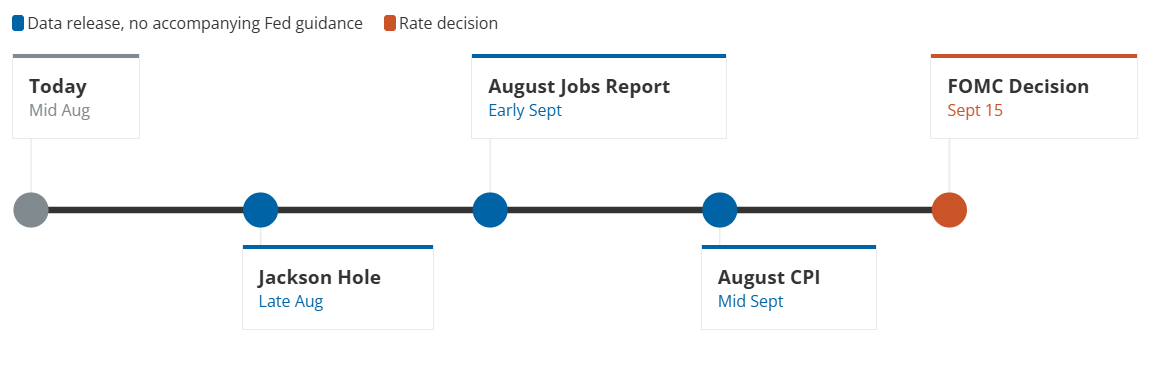
That gap is where the next 30 to 60 days will trade. Jackson Hole in late August and the September 15-16 FOMC meeting bookend a stretch where every CPI, PCE, and payrolls release carries more of the signal than it used to, because the Fed isn't supplying a supplementary one.2
The Dissent Math
At Warsh's first meeting in June, the vote to hold was unanimous, but the Summary of Economic Projections split the committee down the middle: nine of the eighteen policymakers who submitted projections penciled in at least one more hike by year end, nine did not, and Warsh, the nineteenth, declined to submit a projection at all.3
By July, the hawkish camp had shrunk, but the metric changed with it. Three regional Fed presidents, Cleveland's Beth Hammack, Minneapolis's Neel Kashkari, and Dallas's Lorie Logan, formally dissented from the hold vote, each preferring a 25 basis point hike.4 Three dissents against eighteen total committee seats works out to roughly 16%, down from the 50% share that leaned hawkish on the June dot plot.
It's worth being precise about what that comparison is and isn't. The June figure came from projections, a survey of where policymakers think rates should sit by December. The July figure came from an actual recorded vote. They're not the same instrument, and two data points don't make a trend line. But the direction is consistent, fewer voices pushing for a hike now than were signaling one two months ago, even as inflation has run above target for five years and Warsh himself has called it “a choice.”5 Traders leaning on this as a guidance signal should treat it as context, not a substitute for the guidance the Fed has stopped providing.
Where the Rate Sensitivity Shows Up
Financials and regional banks. Bank margins move with the curve, and regional banks carry the added exposure of a loan book concentrated in one geography and one funding structure. A hold markets read as durable is a different trade than a hold markets read as one dissent away from a hike, and the FOMC has now produced both reads with a nearly identical statement. That makes bank and regional bank equities a direct line to how each data print gets interpreted.
Homebuilders. Mortgage rates track the long end of the curve more than the fed funds rate itself, but a Fed that's stopped signaling makes the whole curve harder to forecast, and homebuilder stocks are already trading on thin patience for rate relief. Any data surprise that shifts the rate path shows up in this group quickly.
Utilities. Utilities carry bond-like duration and typically get bid up when traders expect cuts and sold when they expect hikes. With the Fed no longer volunteering which way it's leaning, that repricing happens almost entirely on the data.
Small caps. Smaller companies tend to carry more floating-rate debt and less pricing power than the S&P 500's largest names, which makes the Russell 2000 a magnified read on rate expectations.
The Trade Ahead
Warsh is expected to speak at the Jackson Hole Economic Policy Symposium in late August, and the next FOMC decision lands September 15-16.6 Between now and then, every jobs report, CPI print, and PCE release effectively stands on its own instead of being one input the Fed will contextualize afterward. The July payrolls miss is the template for what that looks like. Whether the next print breaks the same way or reverses it, financials, regional banks, homebuilders, utilities, and small caps are the sectors most likely to move first and hardest.
1 Yahoo! Finance, “Why Kevin Warsh Might Raise Interest Rates at the Next FOMC Meeting, Despite a Weak Jobs Report,” August 10, 2026. Accessed August 11, 2026. https://finance.yahoo.com/economy/policy/articles/why-kevin-warsh-might-raise-214148856.html
2 Fox Business, “July FOMC: Fed holds interest rates steady,” July 29, 2026. Accessed August 11, 2026. https://www.foxbusiness.com/economy/federal-reserve-interest-rate-decision-july-29-2026
3 Board of Governors of the Federal Reserve System, “Transcript of Chairman Warsh’s Press Conference” (preliminary), June 17, 2026. Accessed August 11, 2026. https://www.federalreserve.gov/mediacenter/files/FOMCpresconf20260617.pdf
4 CNBC, “Fed rate decision July 2026: Divided Fed holds interest rates steady,” July 29, 2026. Accessed August 11, 2026. https://www.cnbc.com/2026/07/29/fed-rate-decision-july-2026.html
5 Axios, “Fed leaves rates steady, with internal dissent,” July 29, 2026. Accessed August 11, 2026. https://www.axios.com/2026/07/29/fed-warsh-rates-inflation
6 CNBC, “Warsh’s plan for a more opaque Fed will get put to the test by markets on edge,” July 29, 2026. Accessed August 11, 2026. https://www.cnbc.com/2026/07/29/fed-kevin-warsh-markets.html