
Artificial Intelligence, Explained
Editor's note: Any and all references to time frames longer than one trading day are for purposes of market context only, and not recommendations of any holding time frame. Daily rebalancing ETFs are not meant to be held unmonitored for long periods. If you don't have the resources, time or inclination to constantly monitor and manage your positions, leveraged and inverse ETFs are not for you.
A chipmaker announces record demand and the headline touts it as an artificial intelligence (AI) company. A warehouse robotics firm raises capital and the press coverage calls it an AI company. A chatbot developer files to go public and it, too, is labelled an AI company. Yet these are three distinct businesses from different industries with three sets of customers and entirely different economics.
AI is a wide field, and the companies working inside it can behave very differently. Thus, investors and traders are better served by looking past the catch-all label to understand what a company actually builds.
What Artificial Intelligence Actually Refers To
Artificial intelligence* is a field, not a product or a single technique. The National Institute of Standards and Technology (NIST) defines an AI system as one that can, for a given set of human-defined objectives, make predictions, recommendations, or decisions influencing real or virtual environments.¹
That definition is broad and potentially covers a fraud-detection model at a bank, the vision system in a self-driving car, and the software that drafts an email. Those systems, though, can differ substantially in how they are built and deployed. What they share is the goal: performing tasks that would otherwise require human effort and judgment.
Three Eras, Three Different Approaches
AI has gone through a few distinct eras, and a quick walk through them explains a lot about where things stand today in a rapidly changing world.
The rule-based era. The field was named in a 1955 proposal for a summer research project at Dartmouth College, written by John McCarthy, Marvin Minsky, Nathaniel Rochester, and Claude Shannon. Their conjecture was that "every aspect of learning or any other feature of intelligence can, in principle, be so precisely described that a machine can be made to simulate it."² Much of the early work followed a rule-based approach. Engineers wrote explicit rules, usually as “if-then” statements, and the machine followed those instructions. The systems worked inside narrow domains and broke down outside them, because every situation had to be anticipated in advance by a person.
The machine learning era. By the 1990s, the alternative was to stop writing rules and start supplying examples. Machine learning* is the development and use of computer systems that adapt and learn from data with the goal of improving accuracy.³ Rather than being told how to identify fraud, a model is shown many transactions and infers the pattern itself.
The deep learning era. A critical advancement came in 2012, when a neural network* called AlexNet entered the ImageNet image-recognition competition. It won with an error rate of 15.3%, against 26.2% for the second-best entry, using a model with 60 million parameters trained on graphics processors.⁴ The margin was large enough to redirect the field. Deep learning*, the use of neural networks with many stacked layers, became a dominant approach across vision, speech, and eventually language.⁵
The language piece arrived in 2017, when researchers at Google published an architecture called the Transformer, described in their paper as "based solely on attention mechanisms, dispensing with recurrence and convolutions entirely."⁶ Nearly every large language model (LLM)* in use today descends from that design.
The Categories of AI in Use Today
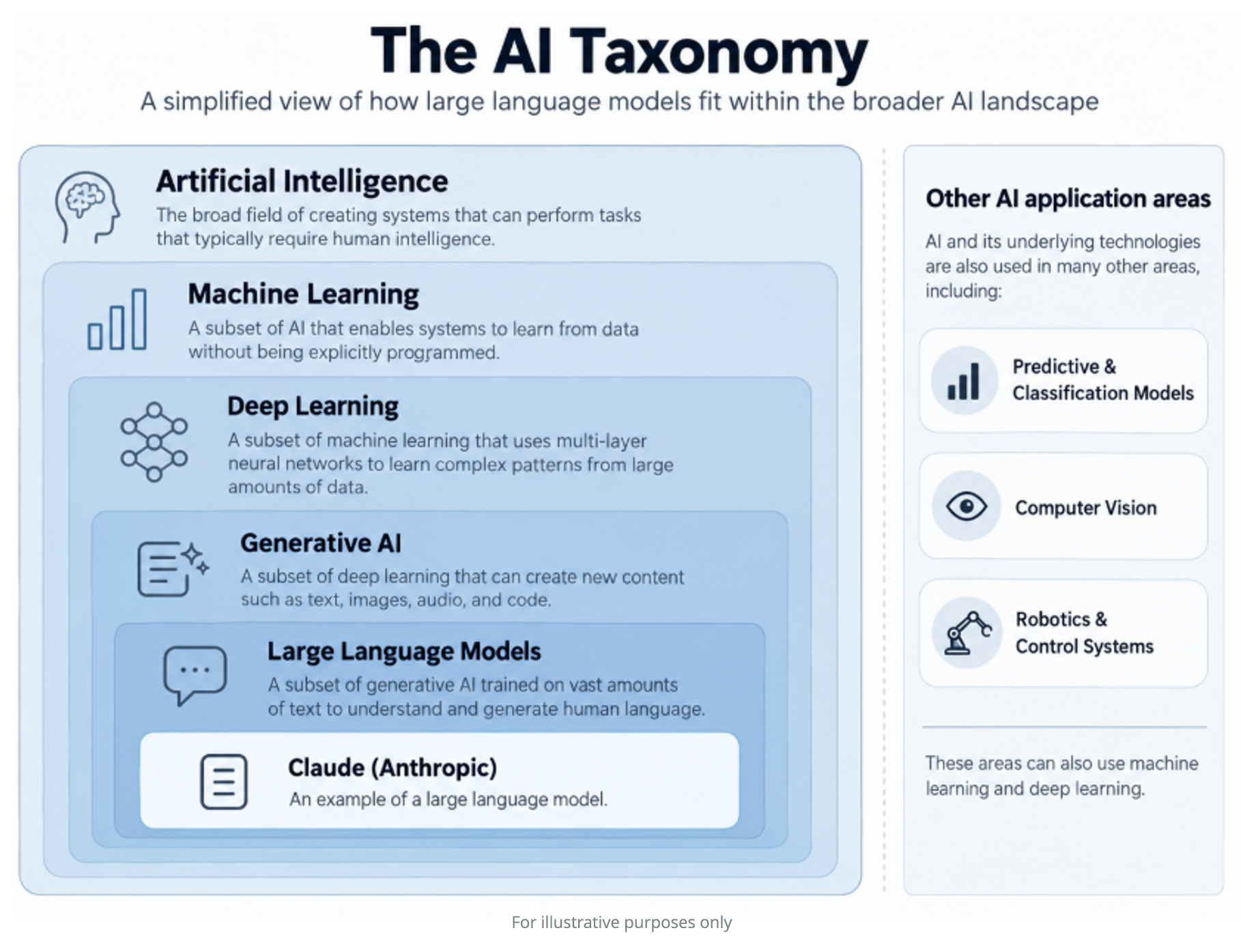
Today's AI landscape includes several distinct categories, all in use at the same time.
Predictive and classification models estimate an outcome or sort an input into a category. Credit scoring, demand forecasting, and spam filtering all exist here. This is the least visible and most widely deployed form of AI in business.
Computer vision interprets images and video. It underpins medical imaging analysis, quality inspection on manufacturing lines, and the perception systems in autonomous vehicles. The U.S. Food and Drug Administration approved 223 AI-enabled medical devices in 2023, up from six in 2015.⁷
Robotics and control systems combine perception with physical action. The distinguishing feature is a machine that moves through the world, introducing engineering, safety, and hardware constraints that software-only systems never face.
Generative AI* produces new content rather than classifying existing content. NIST defines it as the class of AI models that emulate the structure and characteristics of input data in order to generate derived synthetic content, including images, video, audio, and text.⁸
LLMs are one type of generative AI, specialized for text. They are trained on very large text datasets to predict and produce language, and they are the technology behind the chat assistants most people picture when they hear the term "AI."
Those last two terms get mixed up a lot. Every LLM is generative AI, but plenty of generative AI has nothing to do with language. And generative AI is only one corner of the field.
Why the Distinction Matters
Let’s go back to the three companies mentioned above. Each is exposed to different forces:
• A chipmaker sells hardware. Its demand depends on how much computing capacity the industry is building, and its risks are supply chains, manufacturing capacity, and customer concentration.
• A robotics company sells physical machines. Its business runs on manufacturing throughput, deployment cycles, and safety regulation. It can be an excellent business in a year when language models disappoint, or the reverse.
• An LLM developer sells software and access to models. Its biggest costs come from training models and then running them for users, and its competition includes both well-capitalized incumbents and open-source alternatives.
Grouping all three under "AI exposure" obscures more than it explains. The AI category is also broad enough that adoption figures require a close reading: Stanford's Human-Centered AI Institute found that 78% of organizations reported using AI in at least one business function in 2024, up from 55% a year earlier, with 71% specifically using generative AI.⁹ The second figure sits inside the first, which is a useful reminder to check what a given AI statistic is actually counting.
A Concrete Example: Anthropic and Claude
The taxonomy is easier to explain with a real-world case: Anthropic.
Anthropic is an artificial intelligence safety and research company that builds reliable, interpretable, and steerable AI systems, and that develops the Claude series of LLMs.¹⁰
Claude is a product family built on LLMs, which are one type of generative AI. Generative AI is one category within the field of artificial intelligence. Four levels, each nested inside the next, and the company at the top is not the same thing as any of the layers below it.
Anthropic has filed for an initial public offering and has not yet listed.¹¹
Where Direxion Fits
Direxion has filed with the SEC to launch the Direxion Daily Anthropic Bull 2X ETF (ANTO) and Direxion Daily Anthropic Bear 2X ETF (ANTD). ANTO is designed to seek daily investment results, before fees and expenses, of 200% of the daily performance of Anthropic, and ANTD is designed to seek 200% of the inverse of that daily performance. The funds have not yet launched, and the registration statement must become effective before the funds may be sold. The funds seek daily investment objectives, are intended for traders who actively monitor their positions, and are not designed to be held for periods longer than a single day.¹¹
* Definitions & Index Descriptions
Artificial intelligence (AI): A machine-based system that can, for a given set of human-defined objectives, make predictions, recommendations, or decisions influencing real or virtual environments.¹
Machine learning (ML): The development and use of computer systems that adapt and learn from data with the goal of improving accuracy, rather than following explicitly programmed rules.³
Neural network: A computational structure composed of interconnected layers of nodes, loosely modeled on biological neurons, in which each node performs a mathematical operation and the strength of connections between nodes is adjusted during training.⁵
Deep learning: A subset of machine learning that uses neural networks with multiple stacked layers, conventionally at least four, to learn progressively more abstract representations of input data.⁵
Generative AI: The class of AI models that emulate the structure and characteristics of input data in order to generate derived synthetic content, including images, video, audio, text, and other digital content.⁸
Large language model (LLM): A type of generative AI trained on very large volumes of text to predict and produce language. Most current large language models are built on the Transformer architecture introduced in 2017.⁶
Investing in the Funds involves a high degree of risk. Anthropic has not yet completed an initial public offering, and the Funds will not commence operations until Anthropic's common stock is publicly listed. As a newly public company, Anthropic may experience heightened volatility. Unlike traditional ETFs, or even other leveraged and/or inverse ETFs, these leveraged single-stock ETF tracks the price of a single stock rather than an index, eliminating the benefits of diversification. Leveraged ETFs pursue daily leveraged investment objectives, which means they are riskier than alternatives which do not use leverage. They seek daily goals and should not be expected to track the underlying stock’s performance over periods longer than one day. They are not suitable for all investors and should be utilized only by investors who understand leverage risk and who actively manage their investments. The Funds will lose money if the underlying stock’s performance is flat, and it is possible that the Funds will lose money even if the underlying stock’s performance increases, over a period longer than a single day. Investing in the Funds is not equivalent to investing directly in Anthropic.
Information Technology Sector Risk — The value of stocks of information technology companies and companies that rely heavily on technology is particularly vulnerable to rapid changes in technology product cycles, rapid product obsolescence, government regulation, and competition, both domestically and internationally, including competition from competitors with lower production costs.
Software Industry Risk — Companies that develop and implement computer software can face risks associated with intense competition, especially in new product development, deployment and delivery, product obsolescence or saturation, cybersecurity risks as well as changes in regulation especially with respect to consumer or customer data, and risks associated with technology.
Artificial Intelligence (AI) and Big Data Company Risk — Companies engaged in AI and big data typically face intense competition and potentially rapid product obsolescence as well as the risks of increased regulations or restrictions which could have an impact on AI and big data companies.
Anthropic Investing Risk — Investing in Anthropic involves a high degree of risk. Anthropic operates in a rapidly changing and highly competitive industry. Returns depend in part on Anthropic’s ability to develop, train, and commercialize advanced artificial intelligence models and related products and services while managing substantial research, development, and computing infrastructure costs. Anthropic faces intense competition from large, well-capitalized technology companies, emerging artificial intelligence firms, and open-source initiatives. Anthropic relies on third-party cloud infrastructure and specialized hardware, and disruptions, capacity constraints, or cost increases could adversely affect its operations. Anthropic is subject to evolving regulatory scrutiny related to artificial intelligence, data protection, privacy, intellectual property, and content governance, and adverse regulatory developments could impose significant costs or restrict its business model. Real or perceived defects, bias, misuse, or harmful outputs from Anthropic’s models could result in reputational harm, legal liability, or loss of customers. Anthropic may not be able to sustain revenue growth or achieve profitability due to continued investment requirements and market uncertainty.
Direxion Shares Risks – An investment in each Fund involves risk, including the possible loss of principal. Each Fund is non-diversified and includes risks associated with a Fund concentrating its investments in a particular security, industry, sector, or geographic region which can result in increased volatility. A Fund's investments in derivatives such as futures contracts and swaps may pose risks in addition to, and greater than, those associated with directly investing in securities or other investments, including imperfect correlations with underlying investments or the Fund's other portfolio holdings, higher price volatility and lack of availability. As a result, the value of an investment in the Fund may change quickly and without warning. Risks of the Fund include Effects of Compounding and Market Volatility Risk, Derivatives Risk, Counterparty Risk, Rebalancing Risk, Intra-Day Investment Risk, Anthropic Investing Risk, Market Risk, Concentration Risk, Cash Transaction Risk, Non-Affiliation Risk, and risks specific to the information technology sector and software industry, which includes exposure to artificial intelligence. Additional risks include, for the Direxion Daily Anthropic Bull 2X ETF, Daily Correlation Risk, and for the Direxion Daily Anthropic Bear 2X ETF, Shorting or Inverse Risk as well as Daily Inverse Correlation Risk. Please see the summary and full prospectuses for a more complete description of these and other risks of the Funds.